
Successive energy crises make it clear that Europe must rapidly reduce its reliance on
imported fuels and accelerate the deployment of homegrown renewables. Scaling up the
next generation of innovative renewable technologies (iRETs), such as geothermal, next
generation solar and wind, as well as ocean energy, is essential to complement established
renewables and deliver a future-proof energy system.
The Renewable Energy Directive (RED III) includes a target requiring that 5% of new
renewable energy capacity installed by 2030 be of innovative technology, driving a market
demand in the range of 45 GW.1 Its revision is an opportunity to strengthen implementation
and address key policy and funding bottlenecks slowing the industrial rollout of iRETs in
Europe.
Innovative renewables can deliver on Europe’s top energy priorities
- Energy security with home-grown power manufactured in Europe
- Lower electricity prices by increasing the share of low marginal cost penetration in
EU electricity markets - Drive decarbonisation and system flexibility by producing at different times than
established renewables and directly displacing fossil fuels from the grid (both
dispatchability and baseload benefits) - Boost the EU’s industrial competitiveness by scaling up technologies where
Europe leads globally
Extend the innovation target to 2040 to unlock market visibility beyond 2030
The first renewable targets drove the large-scale deployment of established renewables in
Europe by providing long-term market visibility and predictable demand. The same success
can be achieved with the next generation of renewables. The 5% innovation target created
an equivalent market-pull mechanism, driving a market of circa 45 GW2 of innovative
renewable deployment between 2024-2030, supporting the large-scale deployment of the
next generation of renewables. A continuation of this market-pull mechanism in the 2030
2040 period is essential to achieve this.
Scaling up deployment of iRETs and related supply chains requires scaling up private
investment. Clear market signals like the iRETs target are essential to convince private
investors, utilities, and original equipment manufacturers (OEMs) to commit the upfront
capital needed to drive manufacturing and deployment.
The first iRETs target has already proved to be effective in directing private investment
towards the scale-up of European iRETs (successful funding round of CorPower Ocean €32
million raised3, Siemens Gamesa’s plans to commercialise large-scale wind turbines4, and
Drift Energy’s £4.65 million funding round in 2024 to bolster green hydrogen producing
vessels at sea5, or Climeworks’ USD 162 million equity funding round in 20256).
The 5% target for innovative renewables reinforces Europe’s innovation objectives.
Extending the target into the 2040 framework provides both long-term market visibility and
the investment signal needed to unlock more investment and accelerate scale-up.
Leverage public funding and market-based instruments to scale iRETs
Unlock large-scale investment through access to EIB de-risking instruments
A mix of public financial instruments is needed to ensure the right allocation of risks and
enhance the business case for iRETs. Due to their innovative nature, iRETs involve higher
risks than commercial technology. These must be effectively mitigated to attract the private
capital required for scale-up and industrialisation. Blending grant funding, public equity, and
public debt or guaranteed loans, is essential to reduce innovation risks, boost investor
confidence, and unlock large-scale investment.
The European Investment Bank (EIB) provides de-risking instruments, such as venture debt
products and loan guarantees, needed to make a business case for innovative renewable
projects. However, innovative renewables, which struggle to access affordable capital in
order to scale, have only marginally benefited from venture debt and not yet from loan
guarantees. It is crucial to enhance the EIB offer towards innovative renewables, ensuring
that it is able to take on targeted financial risk in this strategic sector for Europe’s future. This
could be achieved under the European Competitiveness Fund, the Industrial
Decarbonisation Bank or by creating an instrument similar to the former InnovFin EDP7.
Deploy market-based instruments to facilitate offtake for iRETs
Member States should implement market-based instruments to boost market creation and
achieve deployment levels implied by the 5% target.
- Net Zero Industry Act (NZIA): the use of non-price criteria (innovation, resilience, system integration) should be further incentivised in NZIA public auctions.
- iRET-specific support schemes: Innovative technology-specific tenders are needed to
support the development of large-scale markets for innovative technologies, as
demonstrated before by established renewables. They drive cost reduction through
economies of scale, as well as technology learnings, and prevent unfair competition
on price with established technologies. Member States should be further incentivised
to implement dedicated tenders to scale up iRETs at home.
Lifting regulatory barriers to accelerate deployments in Member States
Innovative renewables lack dedicated national frameworks, creating regulatory uncertainty
or forcing projects to rely on rules designed for other technologies. This leads to project
delays and financial uncertainty, making it more difficult to attract private capital and
ultimately slowing deployment. Targeted regulatory measures can reduce barriers to
innovation and accelerate iRET deployments:
- Accelerated permitting processes: iRET demonstration projects should be
proportionally shorter than commercial projects and capped at 1 year. - Granting priority grid access to iRET projects to ensure rapid connection of
new flexible assets. - State aid support: iRET demonstration projects should be exempted from state aid
notification to bolster national support.o Under current thresholds8, demonstration
projects require notification regardless of size or market impact9. This deters
much-needed targeted national support as it forces governments to commit
disproportionate resources to comparatively small projects. The entire process
can take up to 2 years, resulting in project delays and increased financial risks.
Helping Member States operationalise the innovation target
Member States are beginning to integrate iRETs in their National Energy and Climate Plans (NECPs),
but references remain high-level and lack support structures such as quantified deployment pathways, dedicated support measures, and monitoring arrangements.
To increase the practical impact of the 5% target and ensure a consistent and effective rollout across the EU, clearer guidance is needed:
- Introduce a standardised definition for iRETs across legislative texts: Currently three definitions exist: two in the Net Zero Industry Act (NZIA) and one in RED III. Our suggested standardised definition is: “Innovative renewable energy technology means entirely new renewable energy technology or not fully commercial renewable energy technology improving comparable state-of-the-art technology.”
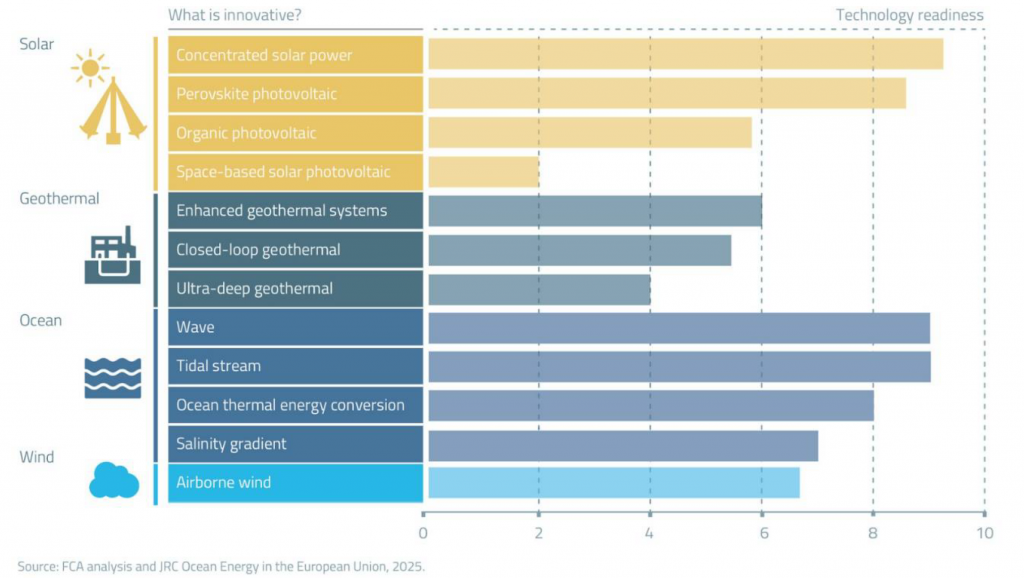
- Provide an indicative list of what would qualify as iRETs, to be updated over time. This graph serves as an indicative (not exhaustive) list of what would qualify:
- Assuming annual capacity growth of 10% for wind and 25% for solar between 2025 and 2030, based on FCA calculations ↩︎
- Ibid. ↩︎
- CorPower Ocean secures €32M series B funding round with investors such as SEB Grentech, Santander, Cisco Investments ↩︎
- Siemens Gamesa executive reveals plan for 21MW turbine | Recharge ↩︎
- PRESS RELEASE: DRIFT plans first green hydrogen producing vessel with close of seed round — DRIFT ↩︎
- Climeworks raises USD 162M to scale up technology ↩︎
- InnovFin EDP used the EU budget as a guarantee to enable the EIB to provide loans and other risk-sharing instruments to first-of-a-kind and pre-commercial energy projects. ↩︎
- Investment aid or operating aid above €30M prompts a notification process ↩︎
- A 50 MW pilot renewable demonstration project would represent only 0,005% of Europe’s existing electricity capacity. ↩︎