
Brussels, 16 April 2026
Executive summary – key suggestions
EREF submits this input to the Commission’s call for evidence on the post-2030 renewable energy framework. The choices made now on target architecture, sector coverage and governance will determine whether Europe builds the cheapest, most secure and most resilient energy system, fully based on renewable energy. To achieve this, EREF strongly suggests focusing on the following points:
1. A binding renewables share target as the 2040 anchor. The post-2030 framework must be anchored in a binding renewable energy target expressed as a percentage of gross final energy consumption; the only metric that captures all end-uses, all technologies and all sectors. EREF’s reference trajectory is at least 80% renewable energy in gross final energy consumption by 2040, with close to 100% in the electricity sector.
2. Binding national targets or enforceable national contributions. The absence of binding national targets is a central structural failure of the current framework — directly evidenced by infringement procedures open against all 27 Member States. The post-2030 framework must reintroduce binding national targets, or at minimum, enforceable national contributions with meaningful consequences for non-delivery.
3. Full protection of the 2030 framework throughout the legislative transition. The post-2030 legislative process must not weaken, reopen or undermine any obligation established under RED III. The recast legislative technique should be used where available. No obligation should be traded away in the name of simplification.
4. Rejection of any “low-carbon” or “clean energy” target architecture that dilutes the renewables-specific investment signal. A framework that subsumes renewable energy under a broader technology-neutral category (whether to accommodate nuclear or fossil gas with CCS) undermines investment certainty for renewable energy and thus weakens Europe’s resilience and competitiveness.
5. Strengthened sector sub-targets across electricity, heating and cooling, transport and industry. The sector sub-target structure established under RED III must be preserved, extended beyond 2030 at appropriately raised ambition levels, and made binding where currently indicative. Waste heat from fossil fuel plants must be explicitly excluded from renewable heating and cooling accounting.
6. An enabling framework for independent producers, SMEs and energy communities. These actors deliver the decentralised transition on the ground. The post-2030 framework must ensure non-discriminatory grid access, accessible PPA frameworks, proportionate permitting, revenue stacking provisions and binding objectives for community energy.
1. Introduction
EREF welcomes the opportunity to provide input to the call for evidence on the renewable energy framework for the decade ahead. This is one of the most consequential legislative processes of the current Commission’s mandate. The choices made now on target architecture, sector coverage, enabling conditions and governance will determine whether Europe will continue building the cheapest, most secure and most resilient energy system — fully based on renewable energy.
Renewable energy is not only Europe’s fastest route to climate neutrality; it is the most powerful lever for energy affordability, supply security, industrial competitiveness and strategic independence from fossil fuel imports. Getting the post-2030 framework right is therefore an economic and strategic imperative. And it should also support those actors who deliver the energy transition on the ground: independent project developers, SMEs, energy communities and cooperatives across EU Member States.
EREF underlines the following priorities for the post-2030 framework:
- A binding renewable energy share target expressed as a percentage of gross final energy consumption, preserved as the central anchor for 2040;
- Sector sub-targets maintained and strengthened across electricity, heating and cooling, transport and industry;
- Full coverage of all renewable technologies — incl. wind, solar, hydropower, bioenergy, geothermal and ocean energy — explicitly and equally;
- Grid investment, storage, demand-side flexibility and market design treated as enabling conditions for delivery;
- Full protection of the 2030 framework and its implementation obligations throughout the legislative transition.
One framing issue must be addressed at the outset. The call for evidence document lists a series of challenges facing renewable energy deployment — grid constraints, low and negative electricity prices, local opposition, and stalling electrification. EREF Members can confirm and provide evidence on these challenges in many EU Member States. However, these are challenges of implementation and enabling conditions, not of ambition. They are arguments for faster grid investment, better permitting and stronger market design — not for lower targets or weaker obligations. Renewable energy is not the source of Europe’s energy system problems. It is the solution for them. In this submission, we provide key evidence supporting a bankable and system-efficient framework for renewable energy after 2030.
2. The evidence base: renewables are delivering
Cost leadership confirmed
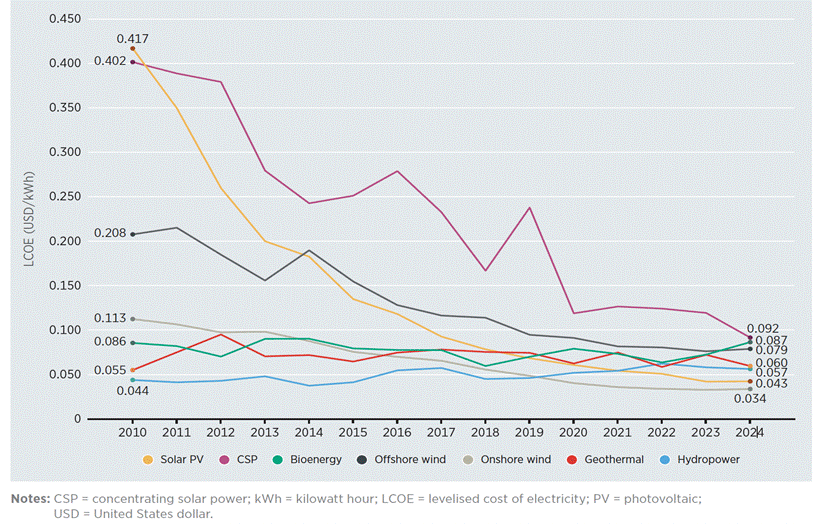
Recent reports confirm that renewable energy technologies have continued their spectacular cost declines since 2010 and have already decisively won the cost competition in global electricity markets (compare Figure 1). Onshore wind, at 3.4 US cents per kilowatt hour, is the cheapest source of new electricity generation; photovoltaics follow at 4.3 US cents.[1] Onshore wind projects commissioned in 2024 were on average 53% cheaper than the cheapest fossil fuel alternative; solar projects 41% cheaper.[2] In that year, 91% of new renewable energy projects were more cost-effective than all new fossil fuel alternatives.[3] By adding 692 gigawatts of renewable capacity globally in 2025, renewables are the overwhelming majority of all new energy capacity at a share of 85.6%.[4]
Figure 1. IRENA Global weighted-average LCOE from newly commissioned utility-scale renewable power technologies, 2010-2024[5]
These cost advantages are not limited to the generation level. According to a recent study by the Dutch Sustainable Energy Association NVDE, based on current energy prices, Dutch households with a heat pump pay on average €135 per month on their energy bills, compared to €240 for a fossil gas central heating boiler.[6] A Dutch wind energy kilowatt hour costs 8 cents in total generation costs; a gas-fired power plant costs 15 cents.[7] Likewise, a driver switching from a petrol car to an electric vehicle with home charging and solar panels pays 6 cents per kilometre for operating it in the Netherlands, compared to 15 cents for a petrol vehicle.[8]
The cost advantage of renewable energy is clearly sustained even at the total energy system level, including grids, storage and back-up capacity. A study by WindEurope and Hitachi Energy mapping total system costs to 2050 across five scenarios found that a renewables-based pathway is the cheapest by a margin of €487 billion to €860 billion compared to scenarios relying more heavily on nuclear, carbon capture and storage, or hydrogen.[9] This difference is roughly equivalent to what Europeans collectively spend on healthcare each year. It holds even after fully accounting for investment in electrification of heavy industry. A slow-transition scenario, where Europe fails to meet its climate targets, would cost €1.6 trillion more than a renewables-based pathway by 2050.[10]
Making use of these cost efficiencies requires getting policies right. IRENA notes that renewable energy costs in Europe and North America could face upward pressure due to structural challenges, including permitting delays, limited grid capacity and higher system balance costs.[11] This finding is crucial: it means that the correct policy response to the system challenges identified in the call for evidence is to address those structural barriers directly — faster permitting, more grid investment, better market design — not to slow renewable energy ambition. Any weakening of the renewable energy framework will increase costs for the energy system, not reduce them.
Energy security
The current geopolitical environment underscores the strategic case for accelerating renewable energy deployment. Following the escalation of conflicts in the Middle East, the cost of fossil gas-fired power in the EU jumped by more than 50%.[12] The contrast between Member States with high renewable shares and those still dependent on fossil gas for power generation is stark. Spain, which has largely achieved a structural decoupling between gas and electricity prices through rapid wind and solar growth since 2019, saw gas influence the price of electricity in only 15% of hours in 2026 so far.[13] In Italy, which remains highly dependent on gas for power and flexibility, the figure was 89%.[14] A study by TNO commissioned by the Dutch Sustainable Energy Association NVDE found that a fully renewable energy system would reduce exposure to a Ukraine-type energy crisis by 80% compared to 2022 levels.[15]
A renewables-based energy system is the most resilient to external shocks in total system terms. In the WindEurope/Hitachi Energy scenario analysis, the renewables pathway has the lowest dependency on energy fuel imports of all net-zero scenarios, with imports representing only 22% of total energy supply in 2050, compared to 54% in a slow-transition scenario.
Jobs and industrial base
According to the 2025 joint report by IRENA and the International Labour Organization, Europe had 2.04 million renewable energy jobs in 2024, of which approximately 1.8 million were in the European Union.[16] The EU wind sector employed 279,100 people; the solar sector reached a record 865,000. These are not abstract statistics: they represent a significant and growing industrial base in manufacturing, installation, operations and services across EU Member States.
However, the solar workforce was estimated to contract by approximately 5% in 2025 (from 865,000 to around 825,000), a development which can be explicitly linked to policy frameworks that fail to sufficiently attract solar investment and to global production overcapacity, placing European manufacturers under competitive pressure.[17] This is a direct illustration of the consequences of weak or uncertain policy signals: renewable energy employment contracts when frameworks are insufficiently ambitious or stable. A strong, binding and predictable post-2030 framework is the most effective instrument for sustaining and growing Europe’s renewable energy industrial base.
3. Priority to ensure implementation of the 2030 framework
Before addressing the post-2030 architecture, EREF underlines that the 2030 framework must be fully implemented and protected throughout the legislative process. Implementation gaps under the existing Renewable Energy Directive remain substantial. All 27 EU Member States are currently subject to active infringement procedures related to incomplete or delayed transposition of the RED, with Sweden already referred to the Court of Justice.[18] The binding target of at least 42.5% renewable energy in gross final energy consumption by 2030 — with the collective aspiration to reach 45% — has not yet been secured in practice.[19] Even assuming full realisation of submitted plans, a 1.5 percentage point gap remains towards the binding EU target.
A central structural weakness of the current framework — the absence of binding national renewable energy targets — has been confirmed by this delivery gap and by the infringement procedures now open against all Member States. The post-2030 framework must address this directly. Binding national targets, or at least clearly enforceable national contributions with meaningful consequences for non-delivery, are a prerequisite for collective achievement of the 2040 objective.
The overriding public interest status of renewable energy projects and the acceleration area framework established under RED III represent important structural gains that must be preserved and strengthened, and extended to infrastructure build-out as foreseen, e.g. by the Permitting Directive as proposed in the context of the European Grids Package. These provisions are among the most operationally significant in the current directive; their full and consistent implementation, where it remains incomplete, must be a core requirement of the revised framework.
The legislative process for the post-2030 framework must not, in any form, weaken, reopen or undermine the obligations and mechanisms established for 2030. Where available, the recast legislative technique should be used to update and extend provisions while preserving the 2030 framework intact. The post-2030 architecture must be additive and forward-looking — not an occasion to relitigate agreed obligations, which would create legal and investment uncertainty precisely when the market needs stability most.
4. A binding renewable energy target as the 2040 anchor
Ambition
The post-2030 framework must be anchored in a binding renewable energy target for 2040, as prescribed in Commissioner Jørgensen’s Mission Letter.[20] The target must continue to be expressed as a percentage share of gross final energy consumption — the only metric that captures all energy end-uses and all renewable technologies, provides cross-sector planning certainty, and generates the long-term investment signals required to mobilise private capital at the necessary scale.
EREF suggests a trajectory towards at least 80% renewable energy in gross final energy consumption by 2040, with close to 100% in the electricity sector, consistent with the at least 90% GHG reduction objective agreed by co-legislators. This is also consistent with the global commitment from COP28 to tripling renewable power capacity by 2030 and investment trajectories outlined in the State of the Energy Union Report 2025. A binding 2045 target should equally be established in coherence with international processes and the corresponding NDC cycle. Setting ambitious and clear milestones now avoids overburdening the years approaching 2050 with deployment backlogs that drive up costs and create investment cliffs.
In parallel, energy efficiency must remain a core pillar in the parallel EED procedure alongside the renewables target. The most sustainable and cheapest energy is the energy not consumed in the first place: efficiency reduces overall system pressure, limits grid reinforcement needs, lowers energy bills for private consumers and industry, and makes high renewable shares more cost-effectively deliverable. Its treatment as a core pillar must be maintained in the post-2030 framework.
Legal nature of the target
In the spirit of simplification, EREF suggests the reintroduction of binding national renewable energy targets. The absence of binding national targets has been confirmed as the central structural weakness of the current framework — directly evidenced by the delivery gap and the infringement procedures now open against every EU Member State. Reintroducing binding national targets would also reduce administrative complexity: with clear national obligations in place, the reporting and gap-filling architecture could be simplified without sacrificing accountability, consistent with the simplification objectives of this revision.
At the very least, the current RED III target structure anchored in Article 3 — a binding EU-level target supported by national contributions — should be secured, extended, and strengthened into the post-2030 period, with stronger gap-filling mechanisms and meaningful consequences for non-delivery.
Risk of low-carbon
Any approach that replaces a renewables-specific target with a single overarching “clean energy” or “low-carbon” architecture — with renewable energy embedded only as a minimum threshold — must be firmly rejected. Such a framework would dilute the specific investment signals that renewable energy developers, independent producers, SMEs and energy communities depend on, and risk channelling political and financial focus towards slower, costlier and less flexible alternatives. The resurgence of misleading debates about nuclear energy and fossil gas, the latter allegedly needed to “bridge the transition gap”, must not be allowed to shape and delay and weaken the post-2030 legislative architecture.
On nuclear: evidence is overwhelmingly clear. Nuclear power fails to produce cheap electricity despite decades of public subsidies. Projects such as Flamanville in France and Hinkley Point C in the United Kingdom have suffered from delays of over a decade and cost overruns of multiples of original estimates. The IAEA itself projects that global nuclear investment would need to increase from $50 billion to $125 billion annually by 2050 — capital that would deliver far greater decarbonisation impact if directed towards renewables.[21]
Moreover, so-called “Small Modular Reactors” are being promoted by industry and some governments as a future breakthrough for low-carbon electricity — yet most concepts remain in early development stages with unclear market prospects and numerous unresolved technical, safety and economic issues. There are well-founded doubts, supported by analysis from the Austrian Federal Ministry for Climate Action, that smaller-scale reactors could ever produce electricity more cheaply than large nuclear plants — let alone at costs competitive with renewables.[22] In any case, SMRs cannot be expected to reach commercial viability by 2030, making them irrelevant to the 2040 objective. The debate around SMRs is therefore best understood as a distraction from the urgent and proven task of scaling up renewable energy deployment.
Even at total system level, a nuclear-heavy pathway does not deliver. A nuclear-based energy system scenario would leave Europe reliant on imported fuels for 37% of its energy by 2050 — compared to only 22% in a renewables-based pathway — and would cost €487-860 billion more in total system costs than a renewables-based one.[23] Nuclear energy is fundamentally incompatible with the decentralised, flexible energy system that high renewable shares require; it cannot be quickly and meaningfully be ramped up or down to meet demand fluctuations, and continues to reinforce dependence on vulnerable uranium supply chains, including from Russia.
The EURATOM Treaty of 1957, which remains largely unchanged and continues to provide nuclear with privileged legal standing, preferential subsidy access and a near-complete absence of democratic oversight, must be fundamentally reformed — at minimum through the introduction of a sunset clause equivalent to the one which ended the Coal and Steel Treaty. In the renewable energy framework, nuclear must not be granted a new lease through equal treatment building on a “clean energy”/”low-carbon” label.
On fossil gas: the argument that fossil gas is needed as a “bridge” is equally unfounded. Ember’s analysis confirms that fossil gas — not EU climate policy — is the primary driver of electricity price volatility in Europe.[24] When gas prices spike, electricity prices follow directly: in 2021, the cost of generating electricity from fossil gas tripled, with rising carbon costs accounting for only 12% of that increase. The countries most exposed were precisely those most dependent on gas for power generation. Locking in further gas assets under an ambiguous “low-carbon” framing would extend this price vulnerability for decades, at the direct expense of European citizens and industry. The price risks are just being increased considerably by the ongoing war in the Middle East and the resulting fossil fuel shortage and cost increases.
Hence, renewable energies must remain clearly distinguished as the primary delivery mechanism for the 2040 target, and under no circumstances subsumed into a broader technology-neutral category that obscures these fundamental differences in cost, speed, flexibility and strategic value.
5. Scope of the impact assessment: what must be addressed
Based on evidence, EREF strongly urges the Commission to treat the following areas as core elements of the impact assessment.
Sector sub-targets
The overarching renewable energy target must continue to be underpinned by sector sub-targets for electricity, heating and cooling, transport and industry, as well as dedicated sub-targets for renewable fuels of non-biological origin and synthetic aviation fuels. Sector sub-targets are the operational mechanism through which the headline target is delivered across the whole energy system. They are crucial to ensure that progress is incentivised also beyond the electricity sector, namely in heating/cooling, transport and industry.
Therefore, the sector sub-target structure established under RED III must be preserved and strengthened for the post-2030 period, covering the industry provisions under Article 22a, the transport target under Articles 25 and 27, the buildings provisions under Article 15a, the binding heating and cooling increment obligations under Article 23, and the district heating and cooling provisions under Article 24. All sector targets should be extended beyond 2030 at appropriately raised levels of ambition consistent with the 2040 objective and in view of climate neutrality by 2050. Where targets are currently indicative — most significantly for buildings — the post-2030 framework must make them binding. Waste heat from fossil fuel plants must be explicitly excluded from counting towards renewable heating and cooling targets; crediting it distorts investment signals and creates precisely the fossil lock-in the framework is designed to prevent.
Where sector-specific capacity indicators are more operationally meaningful than share-based metrics, the impact assessment should explore their use as investment signals — for instance, in industry or heating and cooling. Artificial multipliers that inflate reported renewable contributions without corresponding real-world defossilisation must be avoided; reporting must reflect actual uptake. Specific numerical targets for 2040 are the appropriate subject of the impact assessment. The principle of binding and clearly enforceable sectoral accountability is, however, non-negotiable to ensure the most cost-effective transition.
Electrification as an enabler, not a substitute target
Electrification of end-uses is an important enabler for renewable energy deployment across demand sectors and should be supported through appropriate indicators and enabling measures. It cannot, however, replace a binding overarching renewables share target. Electrification on its own does not guarantee decarbonisation — it can be met with fossil-based or nuclear electricity, and a standalone electrification target would provide no assurance that the electricity consumed is actually renewable. Where an electrification indicator is used, it must be framed as a KPI that complements and remains clearly subordinate to the renewable energy headline target, embedded within an ambitious energy efficiency framework.
Furthermore, non-electric renewable energy technologies — including bioenergy, geothermal, solar thermal and aquathermal — must not be neglected when creating an enabling framework for electrification. Even under the most ambitious scenarios, between 50 and 65% of final energy consumption in 2040 is projected to remain non-electrified, particularly in international transport, industrial processes and parts of the buildings sector.[25] Non-electric renewable technologies are therefore indispensable to reduce fossil fuel consumption in these sectors and must be supported. Their potential is not unlimited, however, which makes energy efficiency and the full and equal deployment of all renewable technologies alongside electrification all the more critical. A framework that privileges electrification over the full technology range would narrow Europe’s options precisely when breadth and resilience are most needed.
Full technology coverage
The post-2030 framework must continue to cover the full range of renewable technologies — wind, solar (including solar thermal), hydropower (including aqua thermal), bioenergy, geothermal and ocean energy. All of these technologies are needed and work best in combination, their complementary characteristics providing the diversity, flexibility and resilience that a high-renewables system requires. Capacity-based indicators or support schemes that focus narrowly on variable electricity generation risk crowding out the technologies that make the system as a whole deliverable.
In this regard, hydropower should be adequately supported. Small hydropower alone produces around 7% of EU electricity, and from run-of-river to pumped storage, the technology is instrumental for balancing variable renewable generation. Small hydropower has low volatility, high predictability and modulation capabilities that support power balancing and voltage regulation — making it a relevant contributor to distribution-level flexibility as variable renewable shares increase. Modern hydropower plants are equipped with technology and management measures to ensure ecological river continuity and can create good ecological conditions in water bodies. Reactivating decommissioned plants, refurbishing older installations with modern turbine technology and unlocking the potential of micro and hidden hydropower solutions can rapidly increase Europe’s renewable electricity production and system services. These assets must be valued and maintained, not overlooked.
Bioenergy is equally indispensable. As a dispatchable, storable and largely domestically available energy source, it provides valuable system services. Biomass and Biogas play a strategic role in substituting fossil gas across heating, industrial processes and transport as well as a replacement of fossil gas in producing balancing power; the REPowerEU target of 35 billion cubic metres by 2030 should be implemented in full and form the baseline for an appropriately raised post-2030 trajectory. Sustainability criteria for bioenergy must be strengthened and harmonised across Member States, but must not restrict the operational role of bioenergy as a flexibility and system integration resource.
Defossilisation of buildings, heating and cooling
While the electricity sector has seen remarkable progress, heating and cooling remain the largest and most fossil-dependent part of Europe’s energy system. Almost 50% of all energy consumed in the EU is used for heating and cooling, of which more than 70% still comes from fossil fuels — predominantly imported.[26] The post-2030 framework must place strong and binding emphasis on the defossilisation of buildings and the heating and cooling sector.
Heat pumps, biomass, geothermal, solar thermal and aqua thermal are market-ready and capable of delivering renewable, cost-effective heating and cooling across the residential, commercial and industrial building stock. Modern heat pumps are around three to five times more energy efficient than gas boilers, offering households significant savings on energy bills while reducing fossil fuel imports and emissions.[27]
However, an exclusive focus on heat pumps would be neither cost-efficient nor grid-efficient at scale: renewable district heating and cooling networks — powered by geothermal, biomass, solar thermal and aqua thermal sources — reduce individual grid connection needs and alleviate pressure on electricity distribution infrastructure, and their system value in reducing grid congestion must be reflected in the energy prices consumers pay. Solar District Heating systems, well-established across Europe, hold significant further potential to defossilise heat at community and city scale. Biogases, including biomethane, are versatile and can serve across sectors — from space heating to industrial process heat — and biomethane can reach negative GHG emissions on a life-cycle basis depending on feedstock and production process.
Unlocking the full potential of renewable heating and cooling requires consistent, long-term and ambitious policy frameworks that stimulate demand, attract investment and support manufacturing and workforce capacity. Affordability must be ensured through measures including rebalancing electricity costs away from policy levies, introducing carbon pricing on fossil heating fuels, and targeted investment support. Energy efficiency retrofits, building renovations and one-stop shops for households are essential complements, reducing overall system demand and making renewable heating solutions more accessible and cost-effective.
Market design
Europe needs an energy market architecture built for renewables — not a continuation of structures designed for fossil fuels into which renewables are being forced to fit. The current framework remains too focused on the electricity sector and insufficiently coherent for a system running on renewable energy across electricity, liquid and gaseous fuels, heat and transport. As renewable shares rise above 60%, increasingly longer periods of negative residual load make long-term flexibility solutions — grid enhancement, storage, demand response and Power-to-X — structural necessities. The post-2030 framework must provide the legislative toolbox to manage this transition.
Concretely, the framework must ensure:
- clear rules on priority access for locally and regionally produced renewable energy;
- accessible and simplified power purchase agreements for independent producers, SMEs and energy communities;
- revenue stacking provisions enabling the combination of multiple revenue streams;
- direct supply arrangements for large consumers and energy sharing mechanisms enabling citizen participation and local flexibility procurement.
All direct and indirect subsidies for fossil fuels and nuclear must be phased out — they distort the level playing field and divert capital from the renewable technologies that can deliver at the speed and scale required. An energy taxation mechanism accelerating the phase-out of polluting fuels is an essential complement. The Commission should develop indicative fossil fuel phase-out dates by sector, and make clear that new investment in the fossil fuel cycle is made at the investor’s own risk, without expectation of public compensation when assets become stranded.
On renewable hydrogen: only genuinely renewable hydrogen and its derivatives should qualify as green hydrogen, and clearly distinguished from so-called low-carbon hydrogen. RFNBOs should be prioritised for hard-to-abate sectors — steel, chemicals, aviation and maritime transport — where direct electrification or renewable thermal solutions are not (yet) viable, and must not be directed towards applications where more efficient renewable alternatives already exist. A focus on domestic and regional production pathways will strengthen supply chain resilience and local value creation.
Independent producers, SMEs and energy communities
The impact assessment should also explicitly address the conditions for independent producers, SMEs, energy communities and citizen producers as a distinct and essential constituency. These actors deliver the decentralised, democratic energy transition on the ground but continue to be disadvantaged by market frameworks designed around large utilities, disproportionate administrative burdens and barriers to grid and market access.
The post-2030 framework must ensure non-discriminatory grid access, simplified and proportionate permitting, accessible support schemes and PPA frameworks that work for smaller projects, and revenue stacking provisions enabling the combination of multiple revenue streams. Renewable energy communities and energy citizens must have practical access to flexibility markets and the right to sell excess generation. The assessment should also evaluate how the ambition of the Citizens Energy Package (including the 90 GW community energy target) can be delivered, and if needed, the post-2030 RED must provide a binding foundation.
Public acceptance and participation
Public participation is a precondition for a transition that is both fast and fair. The post-2030 framework must ensure enforceable participation requirements consistent with the Aarhus Convention, evaluate where minimum standards need reinforcing, and embed benefit-sharing as a standard project requirement to avoid duplicate requirements. Participation must be effective, proportionate and predictable. Where it becomes a bureaucratic exercise rather than genuine trust-building, it fails both communities and developers. The EU already has a solid framework in RED III — the priority for the post-2030 revision is full implementation, enforcement and ensuring smaller actors are not disadvantaged by procedures calibrated for large utilities. A decentralised and democratic energy system is a chance of transition and should remain one of its core objectives.
6. Grid, storage and system enablers
Grid infrastructure is the critical enabling condition for renewable energy deployment and a stable, affordable and resilient energy system across the EU. As Bruegel has noted, upgrading Europe’s electricity network is a question of more than money — it requires the right market rules to improve usage of existing infrastructure, well-targeted investment identification, appropriate financing frameworks for network companies, and fair cost recovery from consumers.[28] Cross-border interconnection reduces price volatility and enables renewable generation to flow where it is needed most. Local grid upgrades are essential to accommodate decentralised generation from solar, batteries and electric vehicles.
The framework must also explicitly reflect the significant regional differences in renewable resource availability and system requirements across the EU. Regions with high renewable energy potential — particularly in southern Europe — are well-positioned to become net exporters of renewable energy, provided sufficient cross-border interconnection capacity and market integration are in place. Strengthening north-south electricity corridors, improving the allocation and transparency of cross-border capacity, and facilitating efficient price signals between regions are essential to fully exploit these complementarities, optimise system costs at EU level, and strengthen Europe’s strategic independence from fossil fuel imports.
Critically, the case for grid investment is reinforced, not undermined, by the cost analysis. As the WindEurope and Hitachi Energy study confirms, total system costs in a renewables-based pathway — including full grid build-out, storage and back-up — remain substantially lower than any alternative scenario involving nuclear, hydrogen or carbon capture and storage at scale. Grid investment is not a cost of renewable energy; it is the precondition for realising renewable energies’ cost advantages at system level.
Storage and demand-side flexibility are equally essential, including both short-duration battery storage and longer-duration solutions such as pumped hydro and power-to-gas. The dispatchability of hydropower and bioenergy provides additional system flexibility that complements variable wind and solar generation, and the framework must ensure these technologies are supported in a way that reflects their full system value.
To achieve this, the Post-2030 renewable energy framework should ensure synergies and compliance with the proposals under the European Grids Package.
7. Conclusion
The post-2030 renewable energy framework must be ambitious, comprehensive and enforceable to guarantee to make the full renewables-driven cost advantages available to the EU as soon as possible.
It must build on a meaningful binding renewable energy share target as the central 2040 anchor; maintain and strengthen sector sub-targets across all end-use sectors; cover the full range of renewable sources and technologies; and interlink with initiatives on the enabling conditions — grids, storage, market design, public participation — that make delivery possible in practice.
The evidence is clear. Renewable energy is Europe’s most cost-effective, most strategically secure and most rapidly scalable energy asset. The challenges identified in the call for evidence — grid constraints, system integration costs, local opposition — are important arguments for stronger enabling conditions, not weaker ambition. The renewable energy transition is delivering for European citizens, industry and the climate. The post-2030 framework must reflect this and build on it.
For more information, please contact
Prof. Dr. Dörte Fouquet Dirk Hendricks
Director Secretary General
doerte.fouquet@eref-europe.org dirk.hendricks@eref-europe.org
[1] IRENA (2025), Renewable power generation costs in 2024, https://www.irena.org/Publications/2025/Jun/Renewable-Power-Generation-Costs-in-2024
[2] Ibid.
[3] Ibid.
[4] IRENA (2026), Near-700 GW Surge in 2025 Proves Renewable Energy Resilience, https://www.irena.org/News/pressreleases/2026/Apr/Near-700-GW-Surge-in-2025-Proves-Renewable-Energy-Resilience
[5] IRENA (2025 n1)
[6] NVDE (2026), Duurzame maatregelen zorgen voor lagere energiekosten voor huishoudens en bedrijven, 25 Mar 2026, https://www.nvde.nl/duurzame-maatregelen-zorgen-voor-lagere-energiekosten-voor-huishoudens-en-bedrijven/
[7] Ibid.
[8] Ibid.
[9] Hitachi Energy/WindEurope (2025), Inception Report – Energy System Costs Study, 8 Dec 2025, https://windeurope.org/data/products/energy-system-costs/
[10] Ibid.
[11] IRENA (2025 n 1)
[12] Ember (2026), Latest energy shock reminds Europe of its risky gas reliance, 13 Mar 2026, https://ember-energy.org/latest-updates/the-cost-of-gas-fired-power-in-the-eu-jumped-by-more-than-50-since-the-escalation-of-conflict-in-the-middle-east/
[13] Ibid.
[14] Ibid.
[15] NVDE (2025), Nederland met duurzame energie vrijwel immuun voor nieuwe Oekraïnecrisis, 18 Dec 2025, https://www.nvde.nl/nederland-met-duurzame-energie-vrijwel-immuun-voor-nieuwe-oekrainecrisis/
[16] IRENA/ILO (2026), Renewable energy and jobs: Annual review 2025, Jan 2026, https://www.irena.org/Publications/2026/Jan/Renewable-energy-and-jobs-Annual-review-2025
[17] Solar Power Europe, EU Solar Jobs Report 2025, 2 Oct 2025, https://www.solarpowereurope.org/insights/outlooks/eu-solar-jobs-report-2025
[18] See also, EREF (2025), Sweden referred to EU Court over RED III permitting failure – first case sets important precedent for broader enforcement, 13 Oct 2025, https://eref-europe.org/press-release-sweden-referred-to-eu-court-over-red-iii-permitting-failure-first-case-sets-important-precedent-for-broader-enforcement/
[19] European Commision (2025), State of the Energy Union Report 2025, 6 Nov 2025, https://eur-lex.europa.eu/legal-content/EN/TXT/?uri=CELEX%3A52025DC0667&qid=1762869324977
[20] President von der Leyen’s mission letter to Dan Jørgensen, 1 Dec 2025 https://commission.europa.eu/document/download/35154547-48c1-4671-8d34-13e098859a57_en?filename=mission-letter-jorgensen.pdf
[21] IAEA (2024), Energy, Electricity and Nuclear Power Estimates for the Period up to 2050, 2024, https://www-pub.iaea.org/MTCD/Publications/PDF/RDS-1-44_web.pdf
[22] Austrian Federal Ministry for Climate Action (2024), Small Modular Reactors — Analysis of SMR Concepts, https://www.bmluk.gv.at/en/topics/climate-environment/nuclear-coordination/small-modular-reactors.html
[23] Hitachi Energy/WindEurope (2025 n9)
[24] Ember (2021), Soaring fossil gas costs responsible for EU electricity price increase, 2021, 14 Oct 2021, https://ember-energy.org/latest-insights/soaring-fossil-gas-costs-responsible-for-eu-electricity-price-increase/
[25] négaWatt, Make electrification “Fit for 90”, Jan 2026, https://negawatt.org/IMG/pdf/2026_01_electrification_eu_2040.pdf
[26] Eurostat (2023), Heating and cooling from renewables gradually increasing, 03 Feb 2023, https://ec.europa.eu/eurostat/web/products-eurostat-news/w/ddn-20230203-1
[27] IEA, How a heat pump works, https://www.iea.org/reports/the-future-of-heat-pumps/how-a-heat-pump-workdefossilizes
[28] Heussaff & Zachmann (2025), Upgrading Europe’s electricity grid is about more than just money, Feb 2025, Bruegel, https://www.bruegel.org/sites/default/files/2025-02/PB%2004%202025_2.pdf