
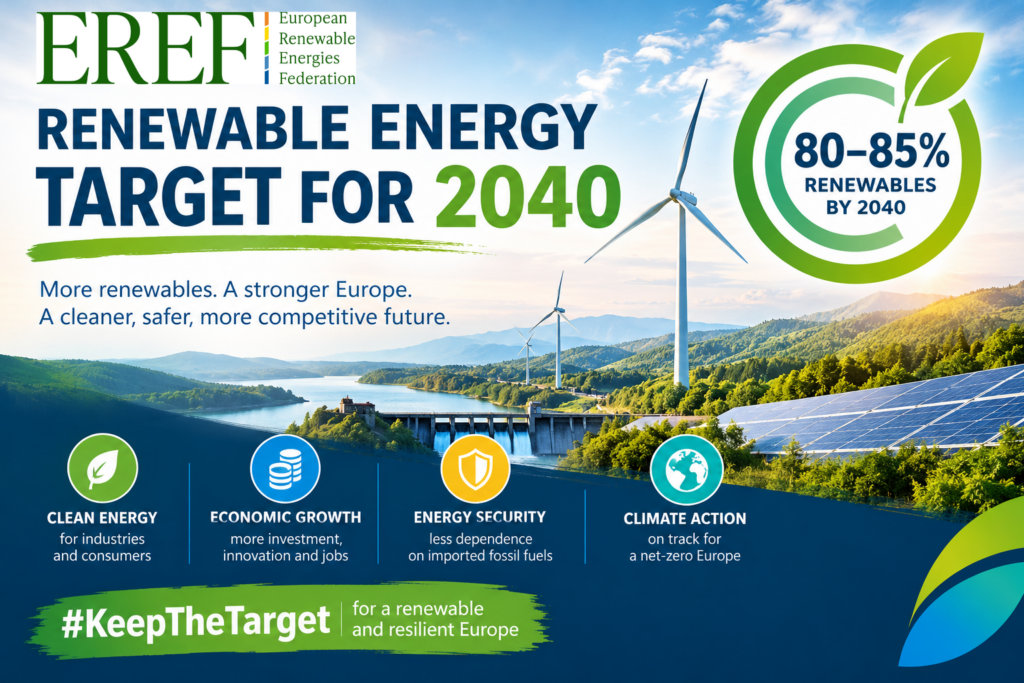
Dedicated EU policies and legislation enabled a successful uptake of renewable energy throughout the European Union. A key reason for this success has been the Renewable Energy Directive and its binding renewable energy target. These targets have provided clear direction, attracted investment, stimulated innovation, and given every Member State a shared objective. It is therefore of the utmost importance to maintain policies that have proved to be successful.
The ongoing shift to renewables continues to decrease the EU’s dependence on imported fossil fuels contributing to stabilize and grow Europe’s competitiveness, and to create high value future-proof jobs. Most importantly, renewables are the only energy sources proven to provide clean, cheap and reliable energy for European industries and consumers during these turbulent times. Together, renewables and energy efficiency are the only force to deliver on climate targets.
Europe’s renewable energy sectors employ more than 1.8 million people directly and 4.5 million indirectly. This workforce contributes over €150 billion to the EU economy and drives more than €200 billion in demand for EU-produced materials, such as steel, aluminium, copper, and cement.
To continue with a fast transition, we need all available renewable energy sources and technologies to reach a decarbonised continent, thereby boosting European economic activity and strengthening Europe’s energy security and resilience.
Targets and reliable frameworks including enabling policies and measures are crucial to deliver these results. They provide assurance to investors and supply chains, and strengthen industrial competitiveness. Setting a clear direction of travel for renewables deployment must be at the core of any successful strategy to counteract the catastrophic effects of climate change and prevent another fossil-driven energy crisis.
A strong 2040 renewable energy target must be backed by faster permitting, appropriate space allocation for renewables and their energy infrastructure, associated strong incentives for electrification and investment in sector coupling.
EREF strongly opposes diluting the renewable energy target by including nuclear or low carbon energy sources or by replacing a renewables-target with a “clean energy” target. This would neither be in line with the Paris Agreement (all GHGs) nor would it support Europe’s energy security and resilience.
EREF underlines that decision makers must avoid incentivizing and thereby locking-in inflexible baseload, as it would be a barrier for the swift adaptation of markets and grids.
An ambitious and binding EU-wide renewable energy target for 2040 must be part of a clear pathway towards phasing out fossil fuels and achieving a net-zero Europe. This should be driven by the rapid deployment of renewables, storage and enabling
infrastructure.
EREF calls on EU decision makers to keep a binding and ambitious EU-wide renewable energy target for 2040. This target should continue to be expressed as a share of Gross Final Energy Consumption and aiming at 80-85% renewable energies by 2040.
This is why EREF supports #KeepTheTarget campaign to secure a binding EU renewable energy target for 2040 (https://www.keepthetarget.eu/).
For more information, please contact
Prof. Dr. Dörte Fouquet
President
doerte.fouquet@eref-europe.org
Dirk Hendricks
Secretary General
dirk.hendricks@eref-europe.org